
The simple difference
AI Safety
What could this AI system do that may harm people?
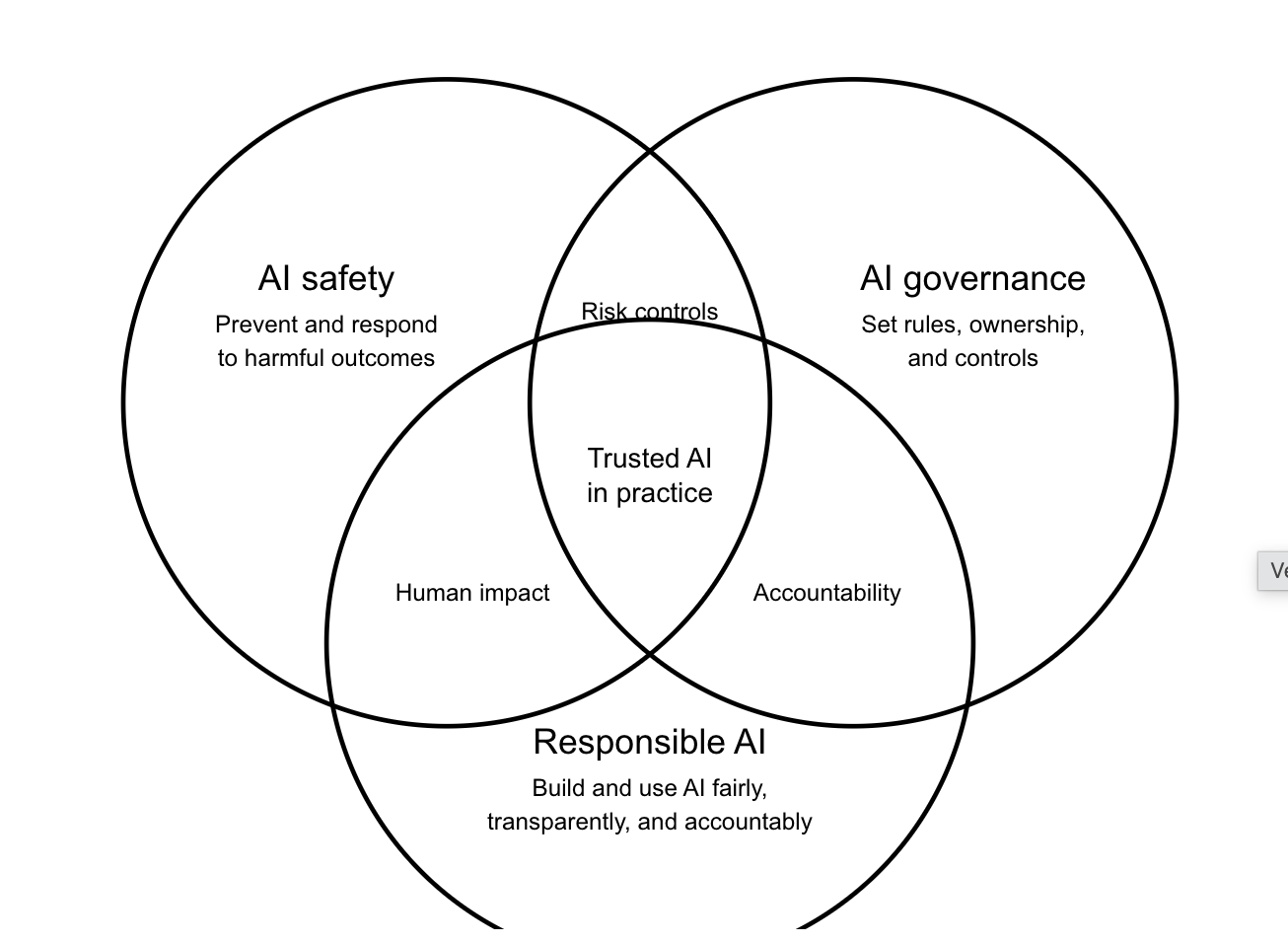
AI Safety focuses on identifying, testing, preventing, detecting, and responding to harmful model behavior or harmful user outcomes.
- Test failure modes before launch
- Identify when human escalation is required
- Monitor harmful errors and near misses
- Improve safeguards when the system fails
AI Governance
Should we use AI this way, and what controls are required?
AI Governance focuses on the rules, decision rights, accountability, approvals, documentation, and monitoring needed to use AI responsibly.
- Approve or restrict AI use cases
- Define owners and decision rights
- Create controls and audit trails
- Review changes after deployment
Responsible AI
Are we building and using AI in a way that is safe, fair, transparent, and accountable?
Responsible AI is the broader practice. It brings safety, governance, fairness, privacy, transparency, and accountability into how a company designs and uses AI.
- Set responsible technology principles
- Balance innovation with real-world impact
- Build trust with users and stakeholders
- Connect AI Safety and AI Governance in practice
One AI use case, three different questions
Imagine a company wants to launch an AI customer-service assistant. The same product can create different questions depending on the lens.
| Lens | The question | What the work may involve |
|---|---|---|
| AI Safety | Could the assistant give incorrect advice, mishandle a high-risk issue, or prevent a customer from reaching a human? | Testing harmful or inaccurate responses, defining human escalation points, and monitoring customer-impact risks. |
| AI Governance | Which customer inquiries may the assistant handle? Who approves those boundaries? What evidence shows the controls are working? | Creating approval processes, documenting prohibited uses, assigning accountable owners, and reviewing evidence after launch. |
| Responsible AI | Is the assistant useful, fair, understandable, privacy-conscious, and accountable to the people who use it? | Setting principles, evaluating customer impact across groups, being transparent about limitations, and improving the system over time. |
How this works across the lifecycle
Example · AI customer-service assistant
Test for inaccurate or harmful responses. Decide which customer issues must always go to a human. Define the use cases that are not allowed.
Use approved boundaries, access controls, escalation paths, and clear ownership for the system and the decisions it makes.
Monitor quality, customer impact, harmful errors, and escalation patterns. Audit the controls and improve them when they are not working.
What this means for people pivoting into AI Safety or AI Governance
You do not need to have held an “AI Safety” or “AI Governance” title before to be relevant for this work.
But your resume and LinkedIn profile need to show the problem you can solve.
- If you are interested in AI Safety, show how you identify harm, test failure modes, improve quality, handle escalations, or protect users.
- If you are interested in AI Governance, show how you translate requirements into controls, approval processes, accountability, evidence, and monitoring.
- If you are interested in Responsible AI, show how you balance product value with fairness, privacy, transparency, safety, and real-world impact.
Your experience may not be the problem. The way you connect your experience to an AI use case may be the missing signal.